
Nordic Threads
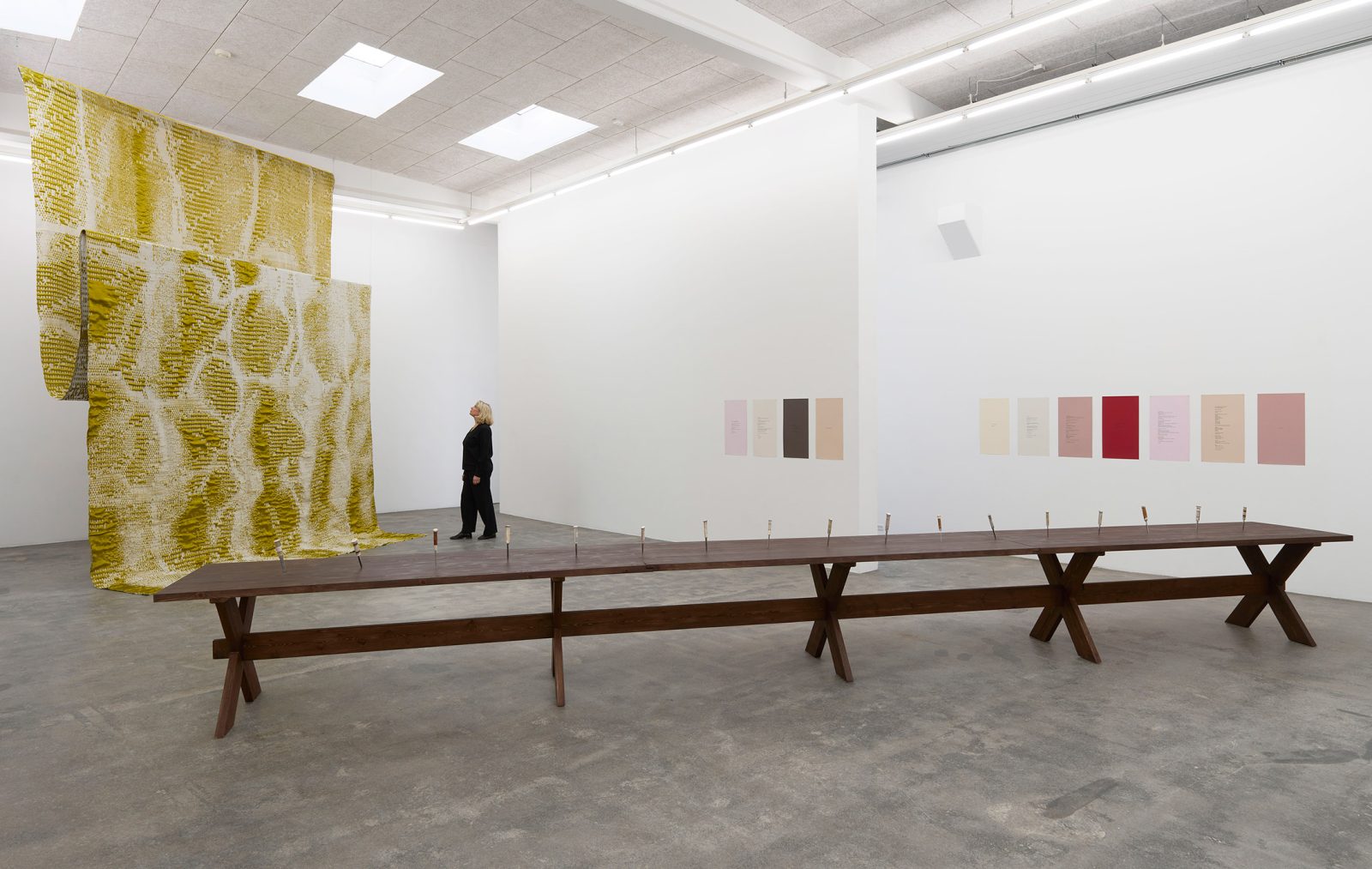
Galleri Nicolai Wallner is pleased to present the inaugural edition of Nordic Threads, a series of exhibitions exploring practices across the Nordic art scene over the past decade. These exhibitions will trace the connective tissue between artists working in the Nordic region, attending to the preoccupations, methodologies, and material languages that have crystallized in this geographic and cultural milieu. Rather than condensing this multifaceted landscape into a neat summary, Nordic Threads emphasizes the many shapes and lines of inquiry that begin in the area. The series operates as an ongoing inquiry, each iteration offering a cross-section of contemporary practices.
This first iteration of Nordic Threads brings together works that engage with domestic and utilitarian traditions through material and formal reinterpretation. Drawing on established cultural forms such as the table, the textile, the room divider, or the family photo, the artists employ processes of transformation rather than direct appropriation. These works reference histories of use, craft, and socio-political significance while deliberately suspending functionality. In doing so, they activate tradition as a living material, capable of generating new meanings within contemporary artistic practice.
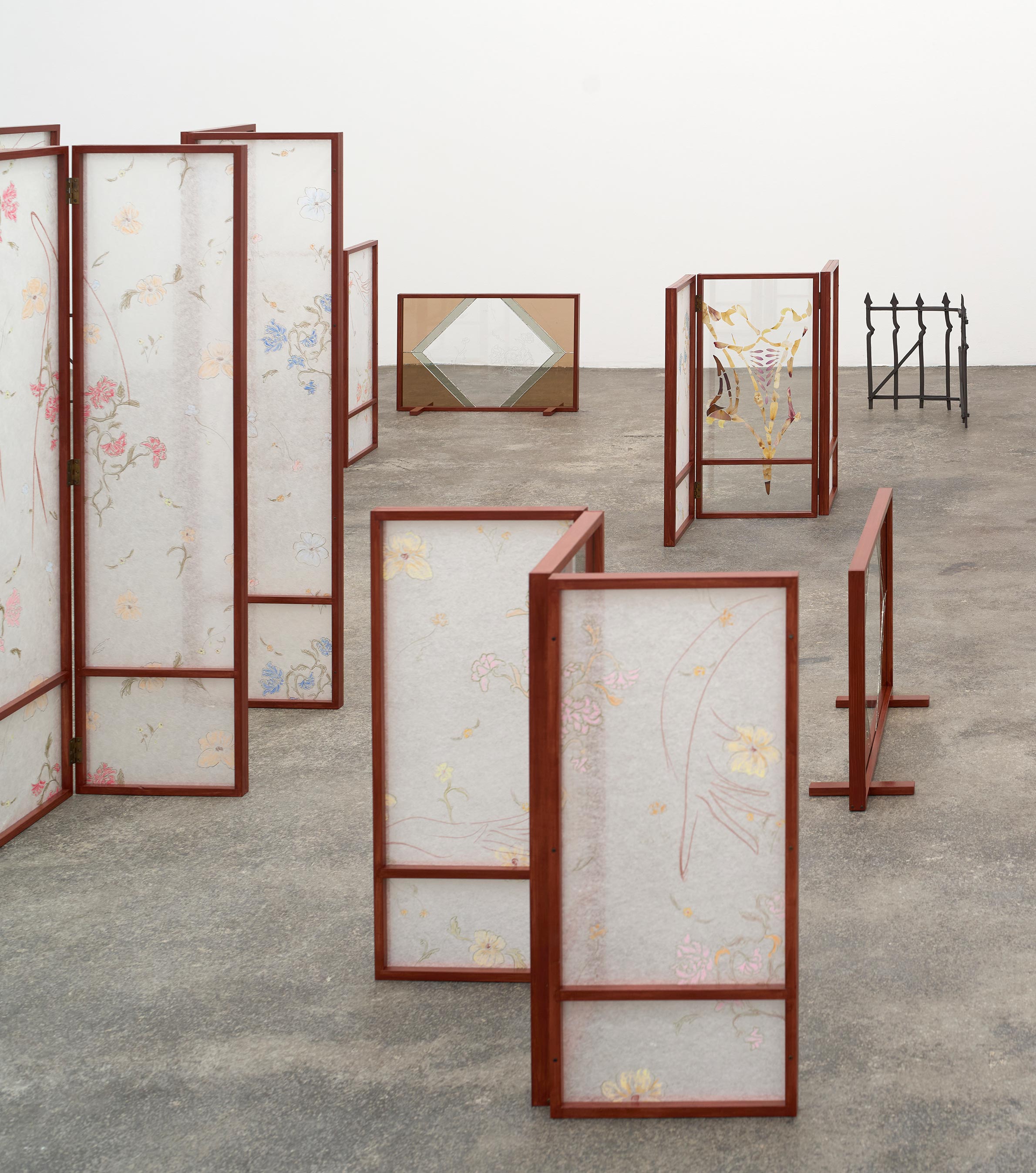
Carola Grahn (b. 1982) recruits the skills of seventeen traditional Sami knife-makers (duojarát) in the making of an unflinchingly physical poem taking place at a long table. Frida Orupabo (b. 1986), reaching into personal, historic, and contemporary digital archives, reimagines violent histories and more intimate negotiations of agency of the Black female body with wall-based collages. Pearla Pigao (b. 1984) employs Norwegian hand weaving techniques as a mode of describing and translating soundscapes, exploring the presence of breath and voice in a single expansive tapestry. With delicate pressed flowers, stained-glass and illustrated Tengujo paper panels, Man Yau (b. 1991) presents an allegory of classical European monarch garden, replacing carefully controlled shrubbery and roses with pingfeng, spatial dividers originating in China, exploring ideals of beauty and the exotic.
What emerges in these four practices is less a unified aesthetic than a shared attentiveness to how materials carry histories and how those histories might be activated, short-circuited, or remade.
To watch interviews with Carola Grahn, Pearla Pigao, and Man Yau, click here.
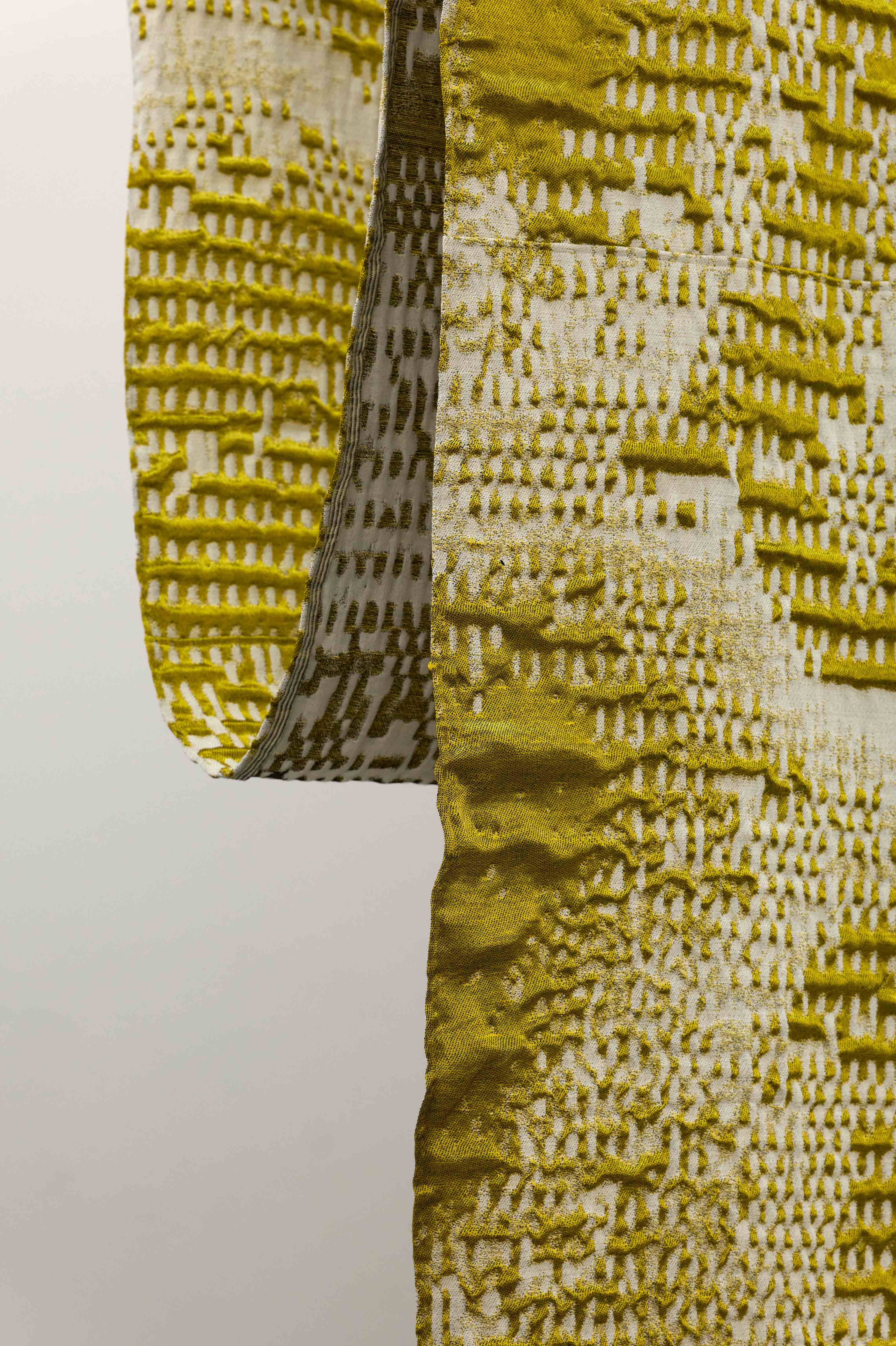
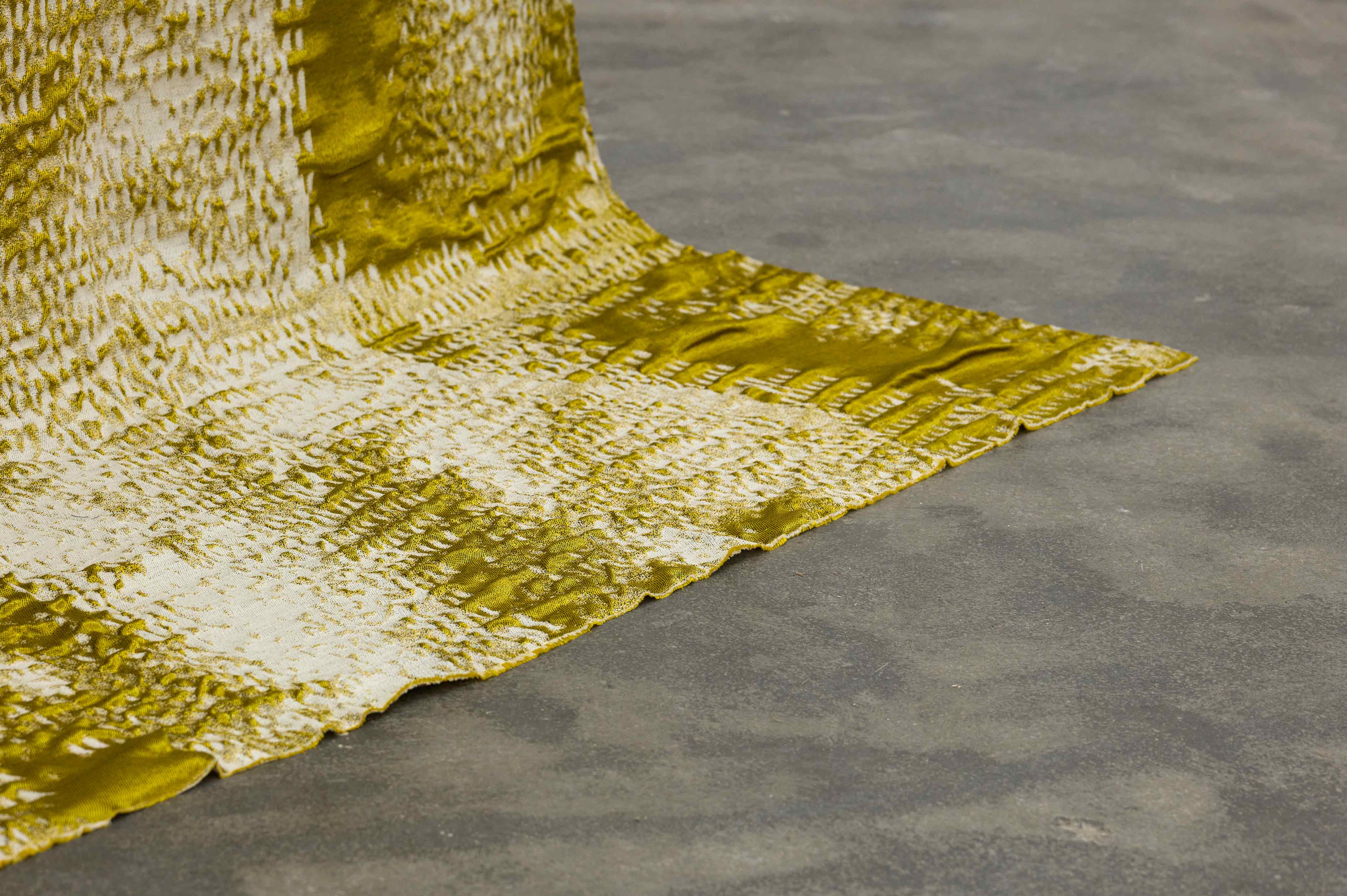
Upon entering the exhibition space, the audience is embraced by Pearla Pigao’s undulating tapestry hung from the tall ceilings in the main gallery space. Its Norwegian wool composition dampens the sound around it, creating a sense of stillness and motion at once. The texture ripples and puckers just so, golden and yellow filaments glinting with the light of the room. The three-dimensional tapestry can be read as a new take on the centuries old practice, harkening back to deeply seated traditions of weaving and textile artistry in Norway used as an artistic, domestic and narrative building tool. However, Pigao takes the abstracting of a visual tradition and turns it on its head. ‘Weaving Voices’, originally exhibited in Pigao’s solo exhibition at Kunstneres Hus in Oslo, takes the human voice as its point of departure.
Being a musician as well as a visual artist, Pigao translates sound into matter. Each textile functions as an almost direct translation of a musical score into a woven pattern, created through innovative manipulations of computational programs. The works resist easy categorization; handwoven yet digitally informed, they blur the lines between expression, technology, and historically feminized craft.
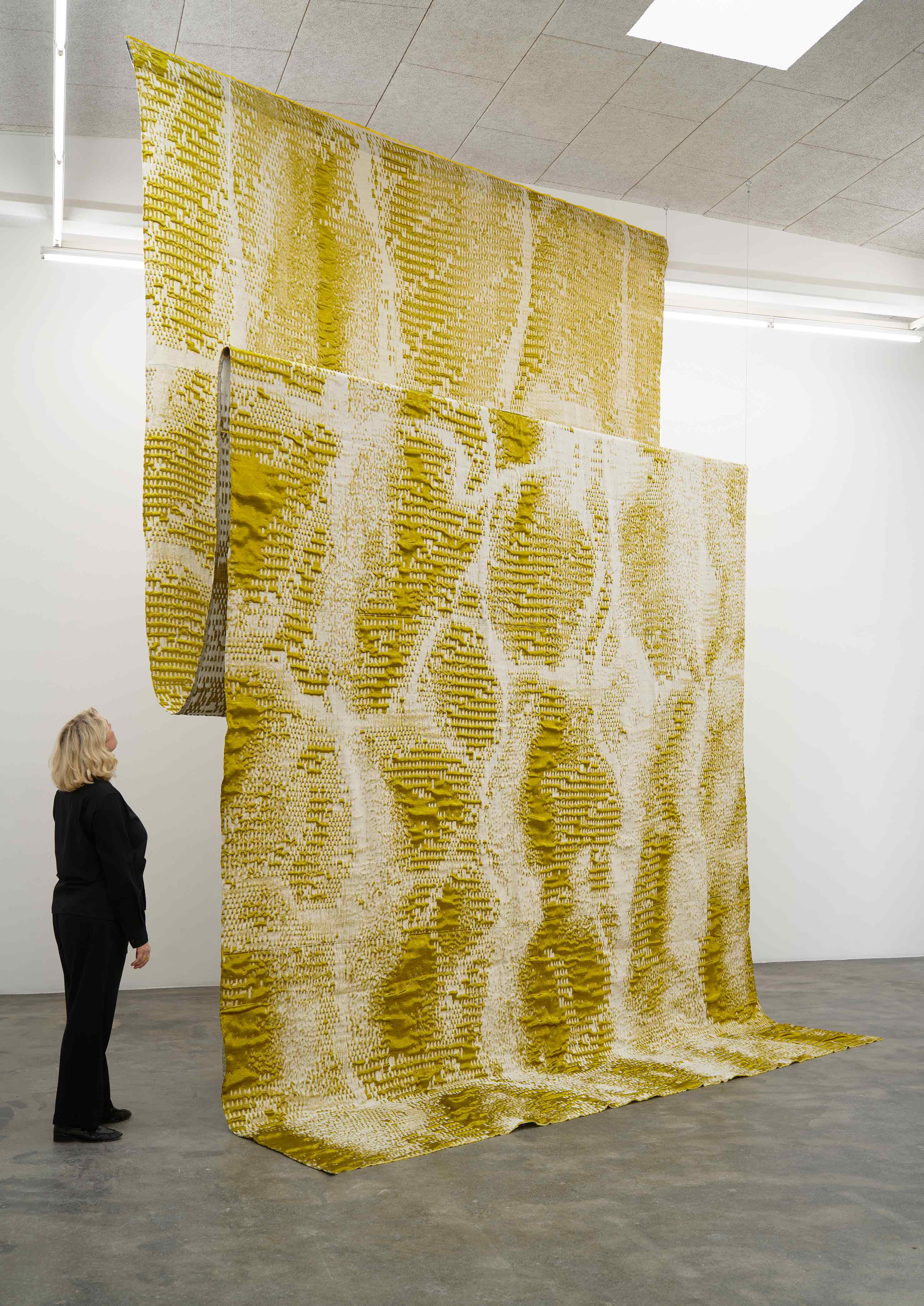
Pearla Pigao
Weaving Voices (2024)
Norwegian wool and yellow polyester filament
400 x 1000 cm
To Inquire
For the work ‘Weaving Voices’, a composition of vocal recordings reflected on the meditative, corporal, and collective experiences that come from the act of singing and breathing. Scientifically speaking, singing in groups elevates human mood and binds a sense of unity. Humming and other forms of low octave of singing commonly used in meditation or religious practices have been proven to stimulate the vagus nerve, bringing the human body into a sense of stability and rootedness. At the same time, the human voice can be used for great violence.
Removed from the sound from which it was born, ‘Weaving Voices’ leads the viewer to speculate on the musical input. Some of Pigao’s works invoke patchy images of a woven basket, some like a topographic map or charting of heat waves on the horizon. Through this synaesthesia, ‘Weaving Voices’ reveals a new mode to read into time, creating something of a new media – a new language for understanding sound, a physical archive of our sonic world. Pigao provides a kaleidoscopic peephole from which to view a vast landscape of human expression.
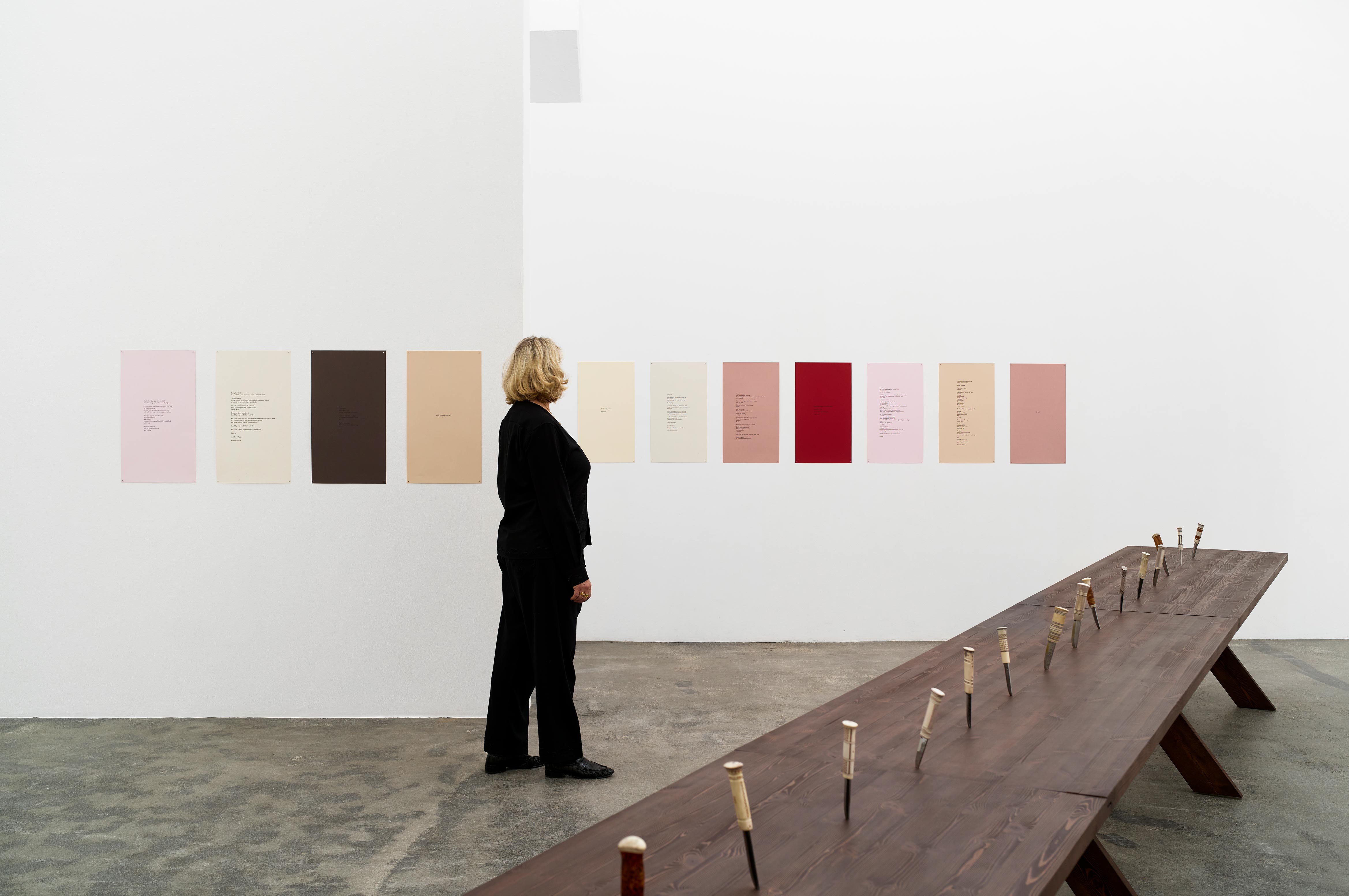
To the left of Pigao’s work, stands a nearly eight-metre-long table, into which seventeen knives have been rammed, creating a spine along the table’s surface. In this work ‘Luhkietjijhtje nejpieh (Seventeen Knives)’ by Carola Grahn, knives by seventeen duojárat (Sami craftspeople) each bear a line from the artist, creating a poem within the installation. Actions that might characterise life in Sæpmie echo like footsteps: “chopping wood, boiling meat, making a fire, bantering, yelling, staring at the ceiling”.

Carola Grahn
Luhkietjijhtje nejpieh (Sjutton knivar) (2025)
Pine wood table, reindeer antlers, wood, steel, knife by Sven Åke Risfjell
96 x 81 x 742 cm
To Inquire
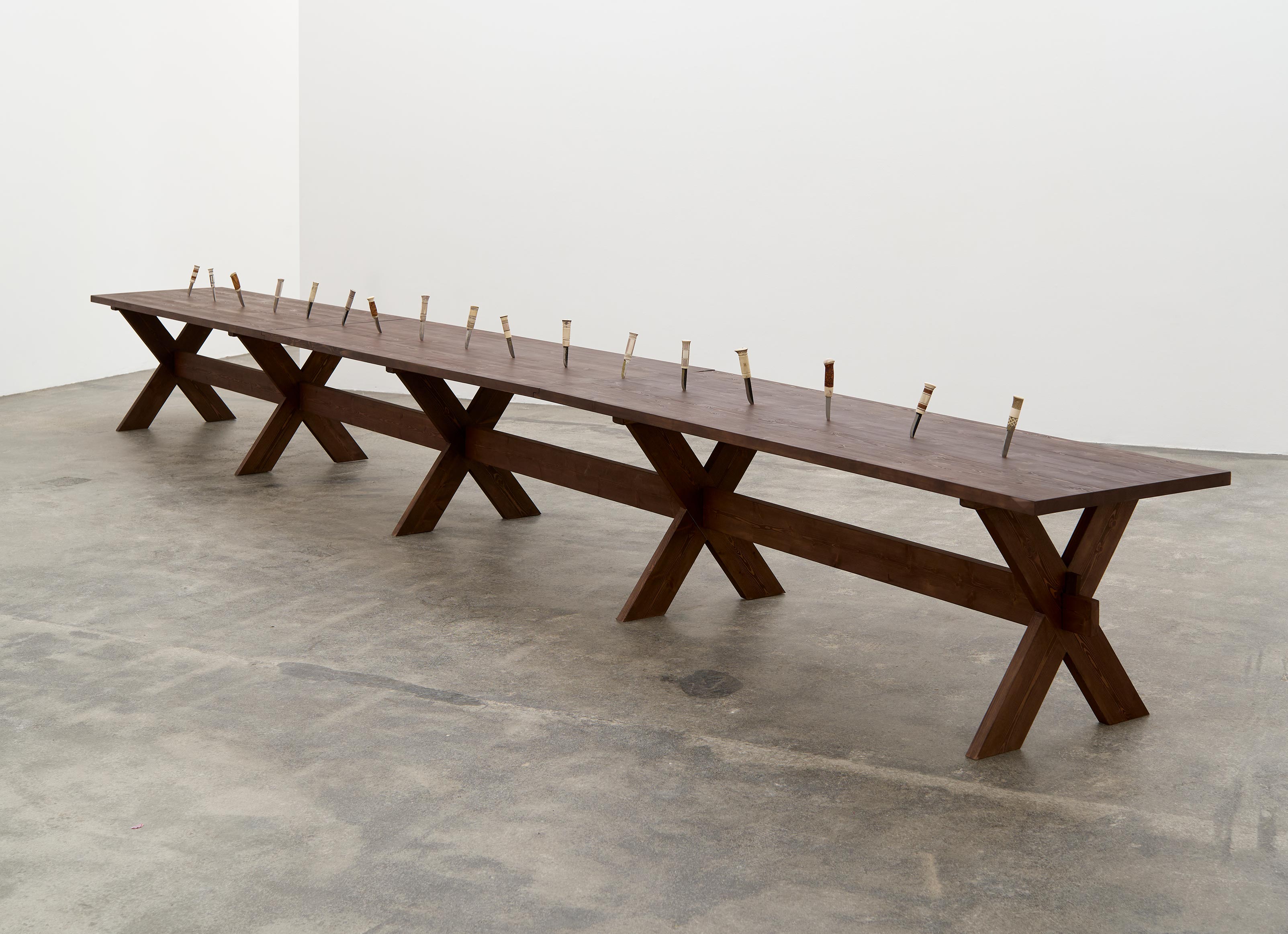
Sami knives, as a sculptural material, are heavily laden with meaning: they are collectors’ items, and each duojár has their own artistry and admirers. Each knife is crafted in the signature style of its maker, reflecting traditions tied to homeplace or ancestry. Motifs and patterns hold within them unique, and sometimes far-reaching, histories.
Grahn makes material the tensions between inner and outer landscapes of contemporary Sæpmie by etching daily, constant, and mundane vignettes onto objects that encapsulate prized and deeply connected ancestral traditions of doudji. The work is one of many dualities: The knife, both a tool for domestic work and a weapon; the table a place for gathering and for conflict; each line in the poem holding within it a romanticism and a tedium.
In this way, ‘Luhkietjijhtje nejpieh (Seventeen Knives)’ creates an image from which the viewer can catch both shadow and light from the material of their own lives, refracting off that which builds the day-to-day.
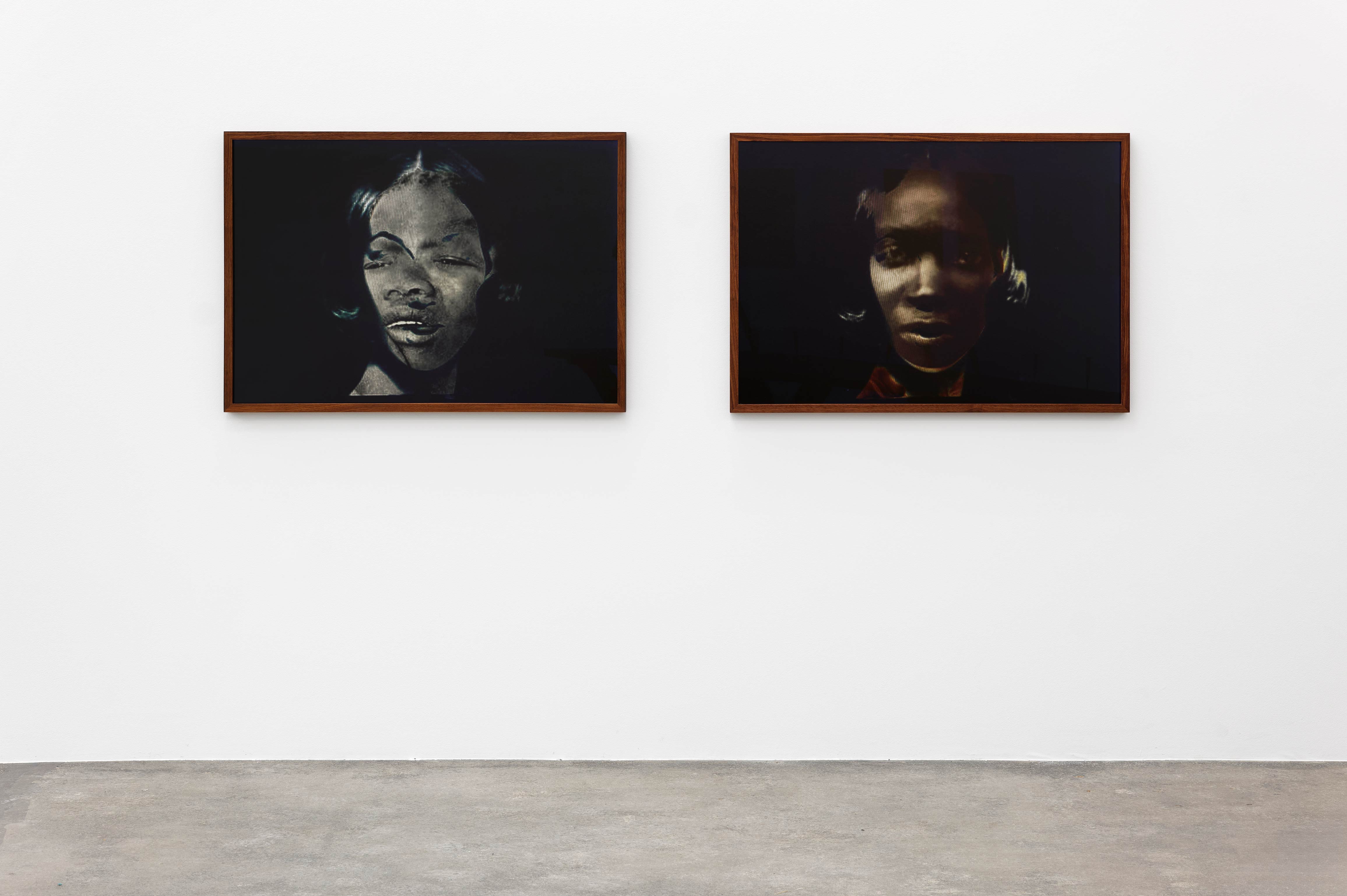
Directly facing the entrance hangs a diptych by one of Norway’s most highly regarded contemporary artists, Frida Orupabo. Originally trained as a sociologist, Orupabo takes historical material as a starting point, working from an awareness of the cumulative documentation of violence that has produced a narrow, reductive image of the Black female body. Through acts of reconstruction, she intervenes in this archive on her own terms, challenging enforced objecthood and reclaiming the possibility of self-authorship. Drawing from domestic family photographs found on eBay, colonial image archives, and contemporary sources such as Tumblr, magazines, and pornography, Orupabo’s practice moves fluidly across time and platforms, foregrounding questions of visibility, ownership, and viability on one’s own terms within image culture.
Frida Orupabo
Women (2022)
Digital print, diptych, edition of 5 + 1 AP
60 x 90 cm and 60 x 100 cm
To Inquire
Collaging multiple images together, Orupabo swings limbs into uncanny positions, warping scale and proportion so that bodies appear fragmented, spliced, or reassembled. Often hanging on the wall like paper dolls, these figures evoke a kind of Frankenstein-ian construction—at once wounded and newly animated. What might first read as mutilation becomes instead a strategy of resistance: reconstructed bodies possess an agency of their own, embracing the layered, malleable nature of the self. Digital collage, in this context, also unsettles assumptions of authorship.
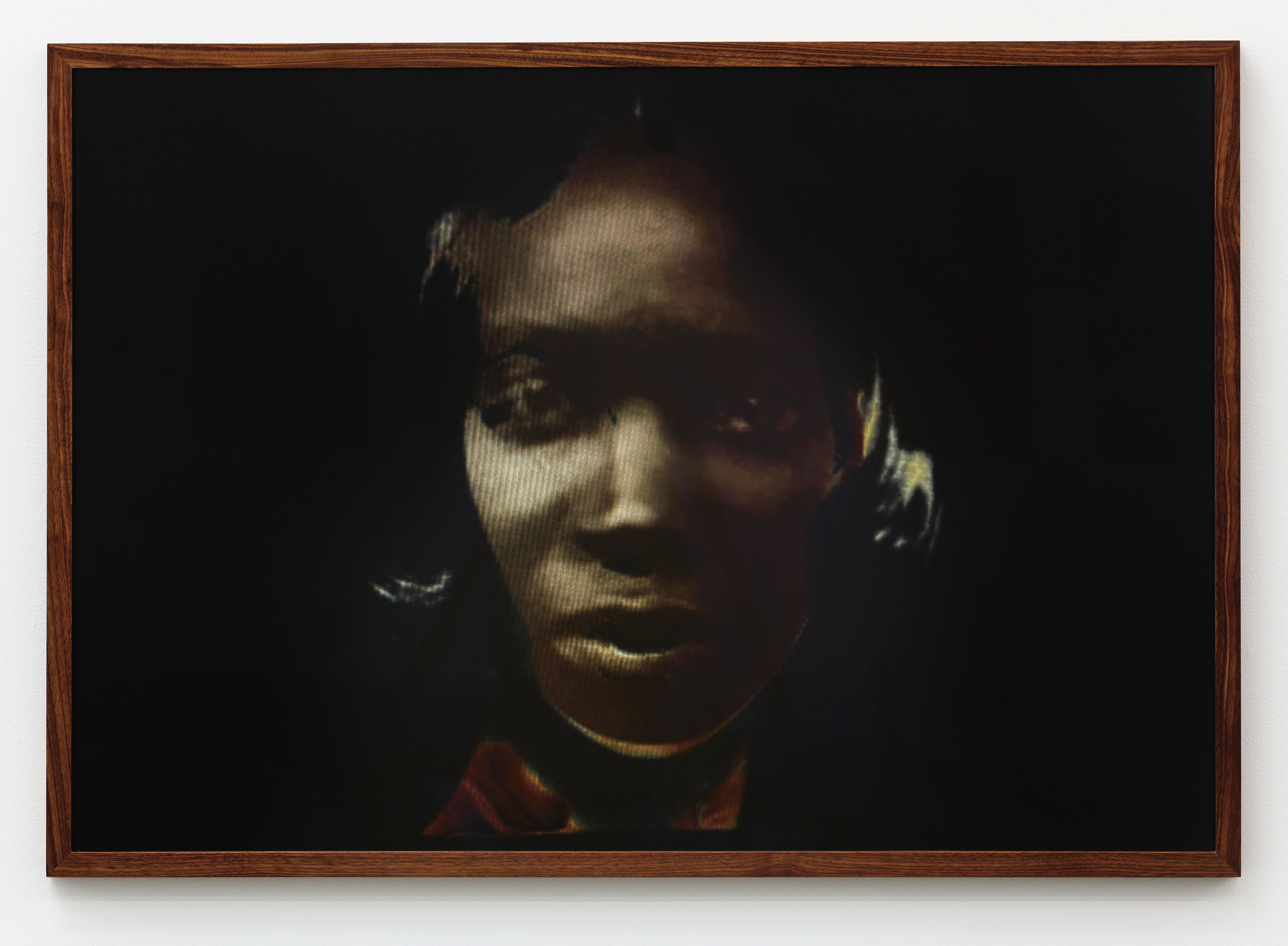
The gaze is the catalyst in Orupabo’s collages, sculptures, and films. She often selects material based on the character of their gaze, seeking ambiguity and confrontation rather than legibility. In ‘Women’ (2022), two faces stare back from a void, layered behind a scarcely traceable third—an image that insists on opacity and resists capture. As Orupabo has stated, “To look back is in a way to refuse objectification. It’s a way of speaking without sound.” This reversed gaze activates attentiveness, working against the hypervisibility demanded of Black bodies while exposing the gaps and silences within official archives and contemporary media culture. In intervening in the endless circulation of images today, Orupabo opens space for resistance, refusal, and the possibility of new narratives to emerge.
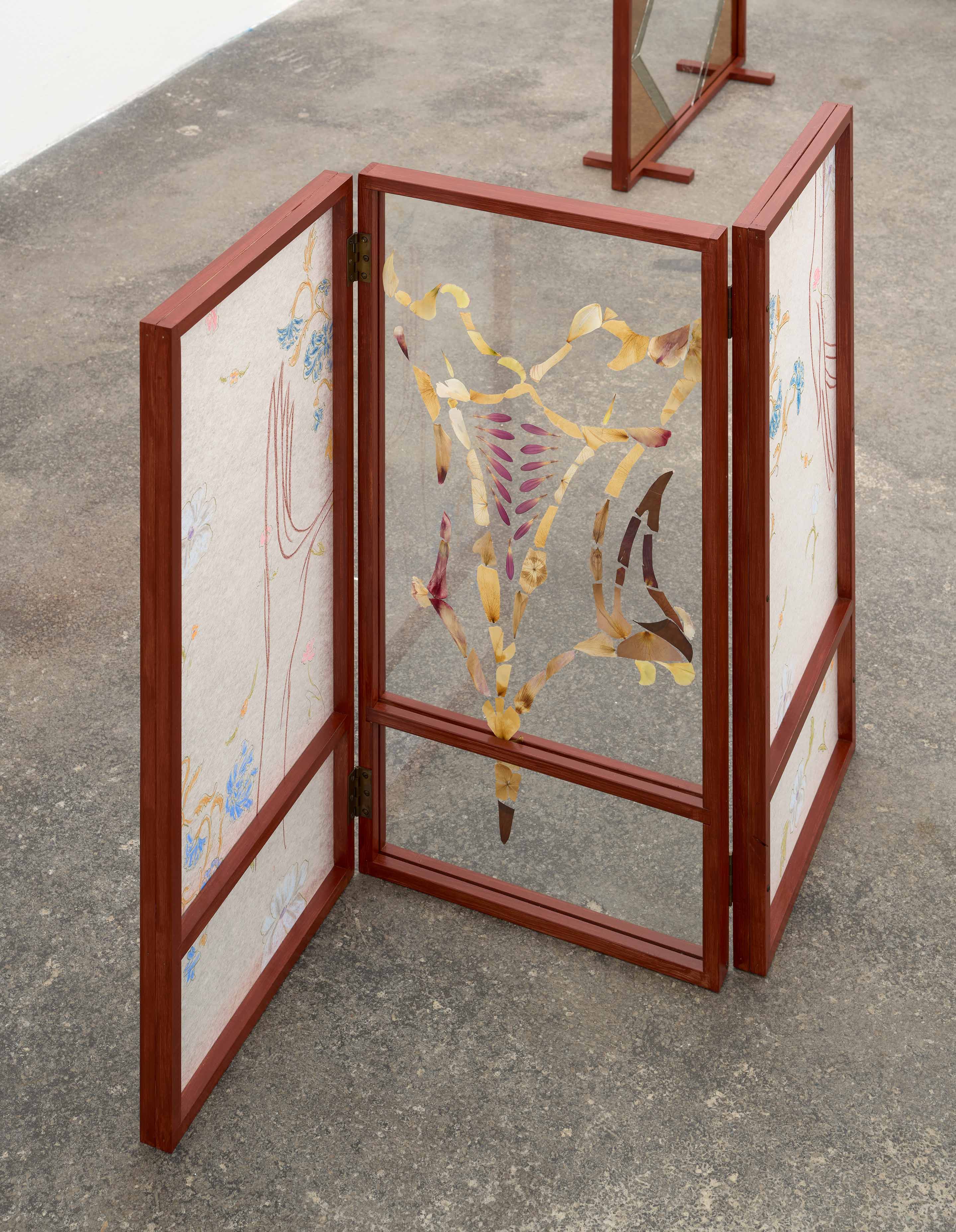
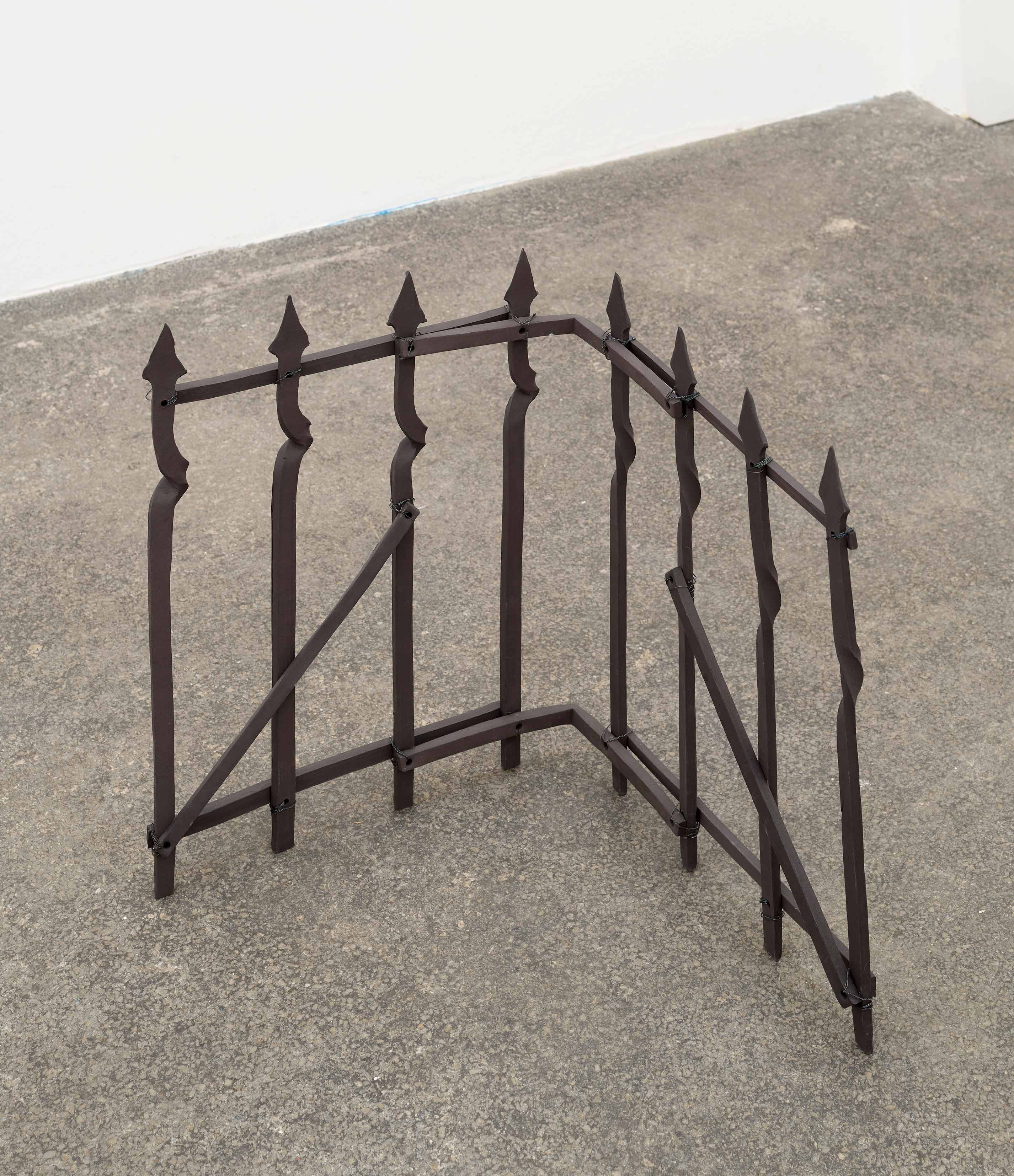
In the second room of the exhibition, the audience comes upon an installation of small-scale sculptures by the Finnish artist Man Yau. This series of works echoes its’ symbolism and connotations from the materials used, the forms they take, and the way they direct the body of the viewer. This layered work considers, as its central theme, the sensation of being on display and the inevitable constriction therein.
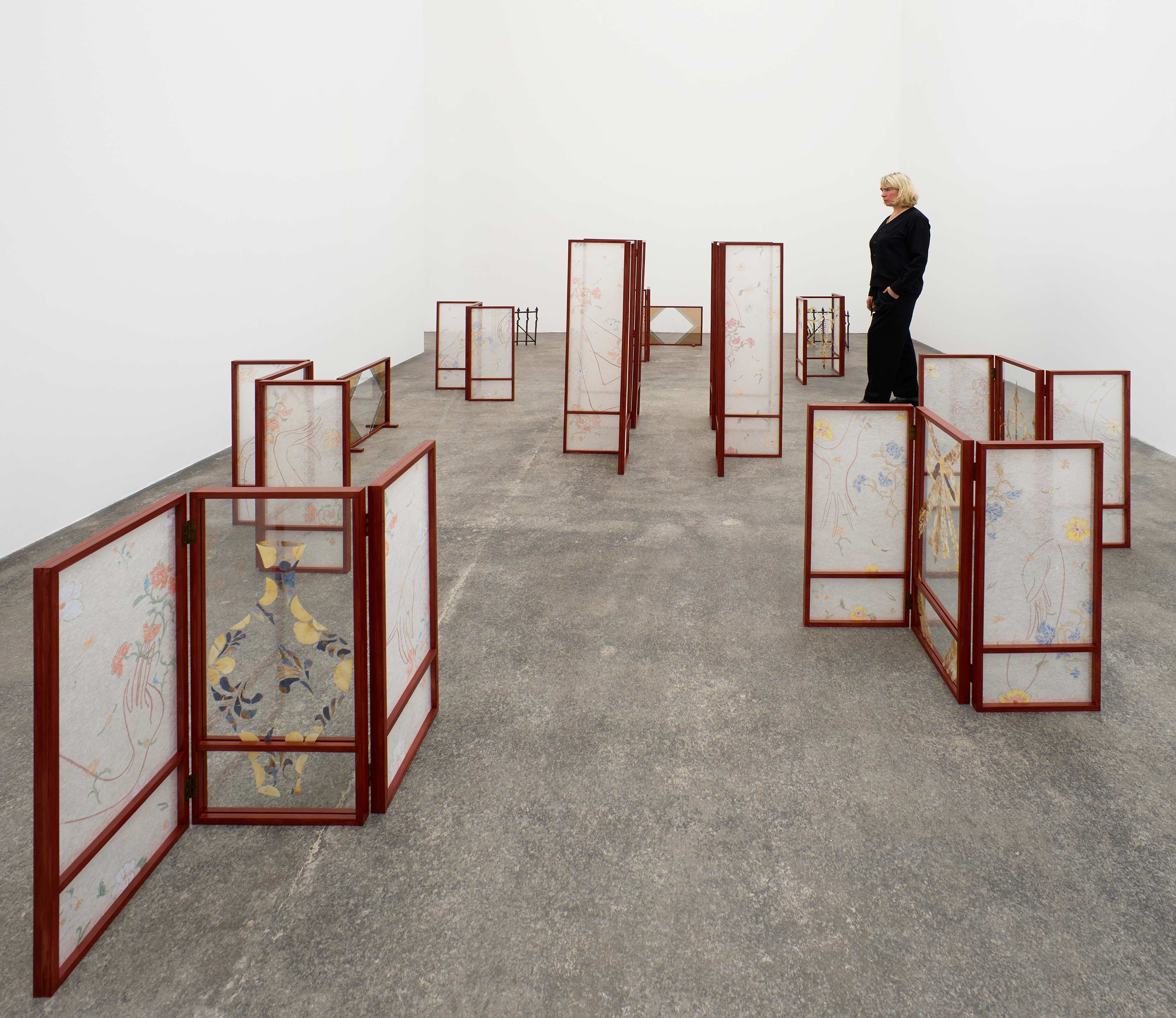
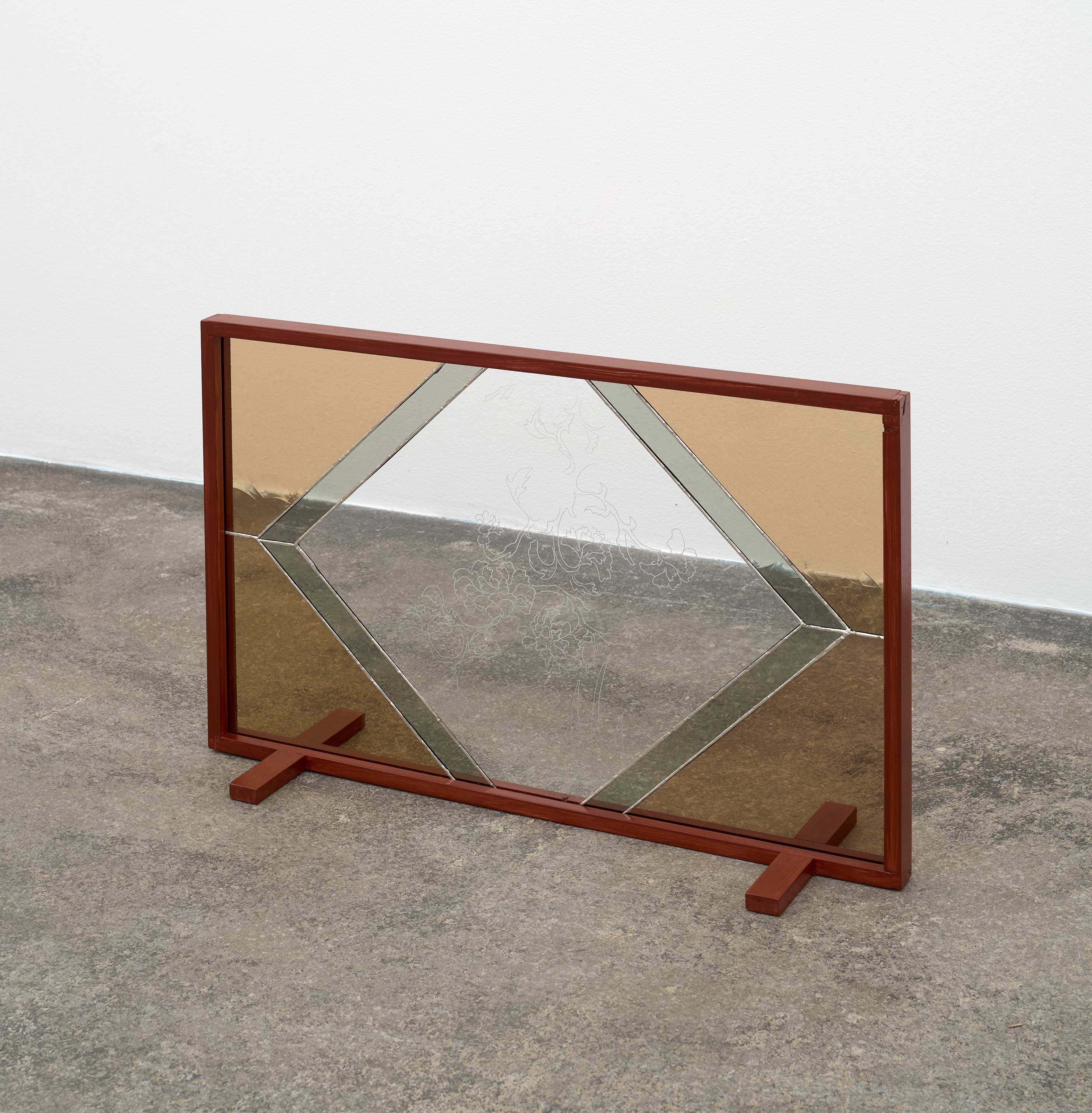
Instead of perfectly trimmed rose bushes or draping lilacs, Yau trims petals into delicately arranged illustrations pressed between panes of glass. The petals’ natural impressions are carefully clipped and placed to depict the desirable – demure fans, tightly laced corsets, and towering chopine shoes. Paper made to be as thin as physically possible displays drawings of forced and distorted body parts, bent into nearly impossible positions. Stained glass invokes fragility and a sense of the sacred.
The viewer walks through the installation as one might walk through royal gardens; through greenery carefully trimmed and coaxed into symmetry and out of its unruly nature. A garden as such annunciates the wealth of its owner by taking wild beauty – that which contains both life and death, colour and decay, and presenting it as groomed, sculpted and perfect. Beset with symbols of the feminine as expressed through precise control, cultivation, and pressure, ’Maze’ short-circuts society’s need to control and commodify that which it elects beautiful.
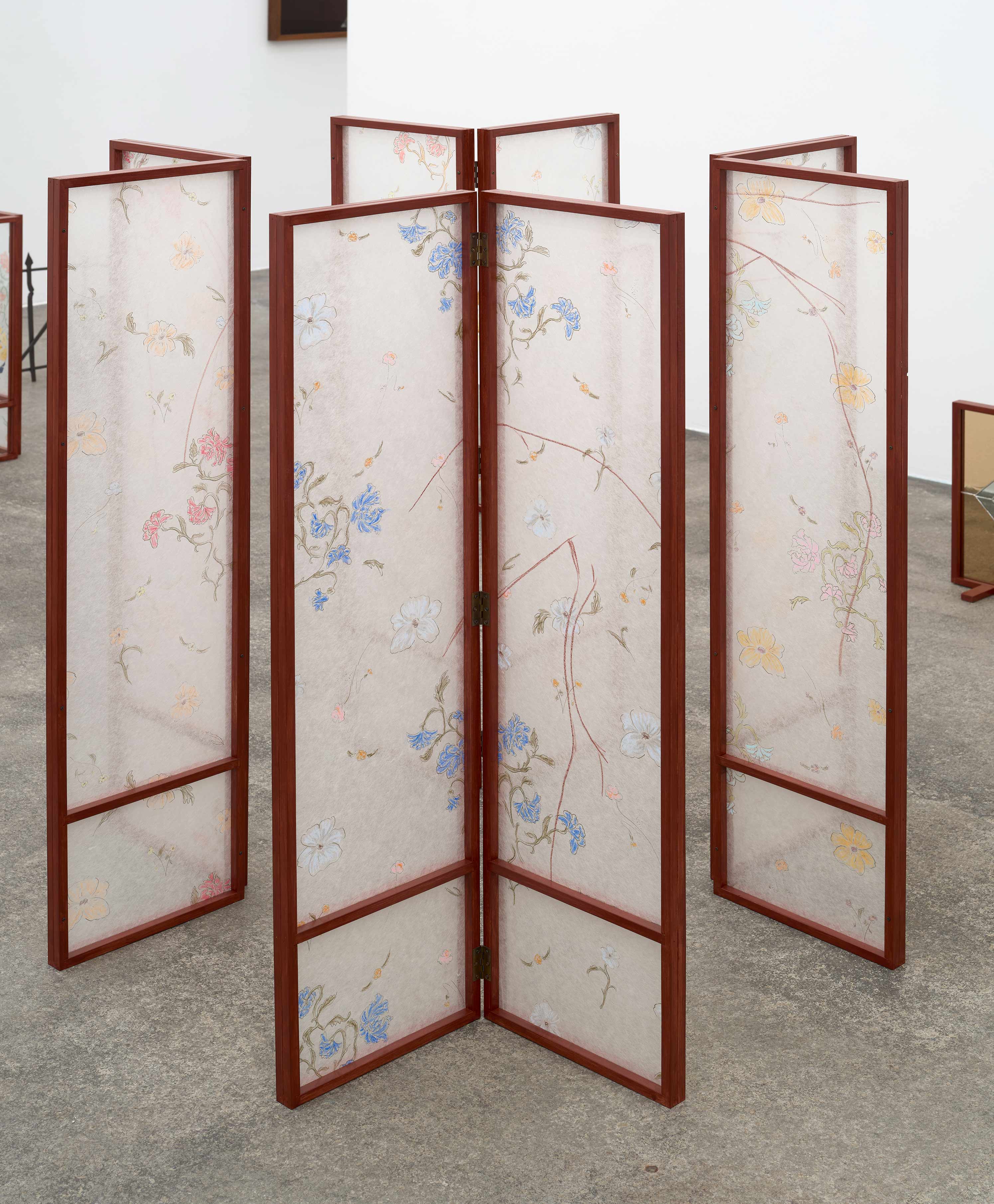
Man Yau
Maze (2024)
Wood, Tengujo paper, dry pastel, screenprinting ink (acrylic), patinated brass
2 panels, each: 125 x 33 x 3 cm
To Inquire
Man Yau
Maze (2024)
Wood, glass, dried plants, Tengujo paper, dry pastel, screenprinting ink (acrylic), patinated brass
3 panels, each: 73 x 33 x 3 cm
To Inquire
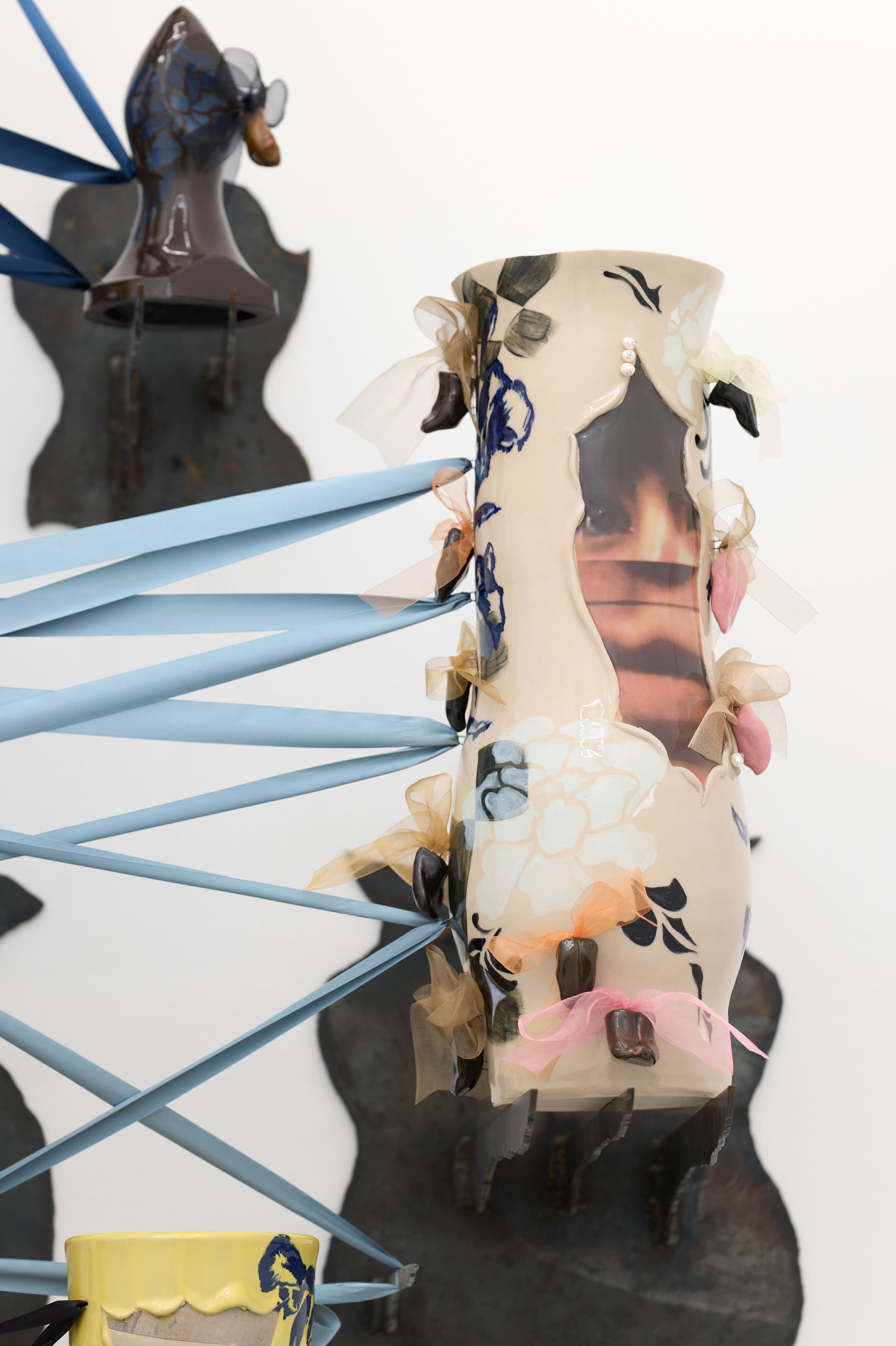
In a small showroom on the opposite end of the gallery, Yau’s work ‘M.Y. Chinoiserie’ juts out from the wall overhead. Referencing similar themes of exoctification, the series of ceramic sculptures refers to the porcelain cabinets often found all over Europe in Baroque and Rococo palaces. The cabinets were collections of Japanese and Chinese porcelain that represented the wealth and power of their owners. Instead of porcelain dishes, the installation presents sculptures resembling ceramic vases and sex toys with Baroque pearls and on-glaze decal details.
In Yau’s work, traditional forms and structures are reappropriated to reflect upon her experience as a woman who is also visibly of a minority background. In both ‘Maze’ and ‘M.Y. Chinoiserie’, material and form create a commentary on the role that everyday objects and aesthetic values play in supporting racialized, gendered and commonly accepted narratives.
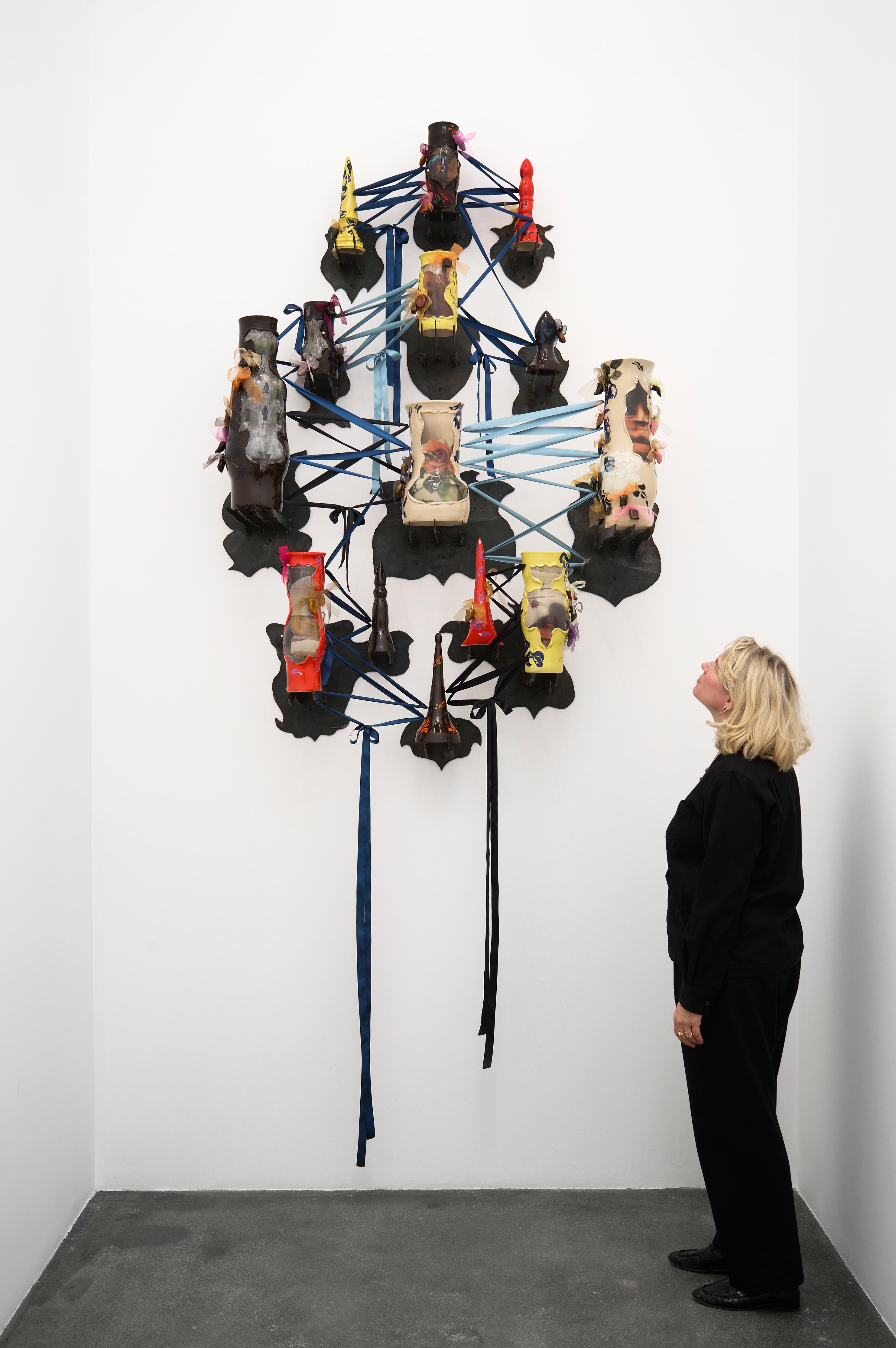
Man Yau
M.Y. Chinoiserie (2021)
Ceramic, glaze, ceramic decals (on-glaze), Baroque pearls, silky ribbon, blued steel
200 x 160 x 60 cm
To Inquire
Carola Grahn (b. 1982, Jåhkåmåhkke, Sæpmie, based in Lund, Sweden) is a conceptual artist working primarily in large scale projects involving sculpture, installation strategies, and the materialization of text and sound. Grahn’s work holds a mirror up to structures of power, politics and identity. Interested in our relationships to nature, to each other and to larger narratives, Grahn often tells universal stories from the personal lens of a woman from Sæpmie.
Carola Grahn received her MFA from The Royal Institute of Art in Stockholm 2013. Grahn has recently presented solo exhibitions at Liljevalchs Konsthall (SE), Wanås Konst (SE), Röda Sten Konsthall (SE), and has exhibited at the IAIA Museum of Contemporary Native Arts (MoCNA) (US), Moderna Museet (SE), The Northern Norwegian Art Museum (NO), Gammel Strand (DK), The Buffalo AKG Art Museum (US), Helsinki Art Biennial (FI), Bergen Kunsthall (NO), Malmö Konsthall (SE), Kunsthal Charlottenborg (DK), PATAKA ART + MUSEUM (NZ), Nuit Blanche Toronto (CA) and Canadian Centre for Architecture, amongst many others. Grahn was awarded the Asmund and Lizzie Arles Sculptor Prize (2021), Aase and Richard Björklunds Foundation (2024) and completed the special commission for Archbishop Antje Jackelén for Church of Sweden (2023).
She is represented in the collections of Samiskt Kunstmagasin (NO), Moderna Museet (SE), The Public Art Agency of Sweden (SE), Mercedes-Benz Art Collection (DE), Göteborg Konst (SE), Konstmuseet i Norr (SE), Ájtte Svenskt Fjäll and Samemuseum (AIDA archive) (SE), Region Jämtland Härjedalen (SE), Östersund Municipality (SE) and the National Sami Competences Centre (NASÁG/NASAK)(NO).
Frida Orupabo (b. 1986, Sarpsborg, Norway; based in Oslo) is an artist whose practice explores questions related to race, family relations, gender, sexuality, violence, and identity. Her works collage personal and found images from online archives into wall-based works on paper, large-scale installations, and video works, intervening in the endless cycle of images that construct the Black female body, both historically and today.
Selected solo exhibitions include Museum of Contemporary Art – MAC/CCB, Lisbon (PT, forthcoming 2026); Sprengel Museum, Hanover (DE); Astrup Fearnley Museum of Modern Art, Oslo (NO); Bonniers Konsthall (SE); Fotomuseum Winterthur (CH); Museu Afro Brasil (BR); Kunsthall Trondheim (NO); Huis Marseille (NL); Portikus (DE); Kunstnernes Hus, Oslo (NO). Selected Biennials and International Exhibitions include the 15th Gwangju Biennial (KR); Okayama Art Summit (JP); 34th São Paulo Biennial (BR); 58th Venice Biennale; and MOMENTA Biennale d’art contemporain × VOX, centre de l’image contemporaine, Montréal (CA).
Selected awards and distinctions include SPECTRUM – Internationaler Preis für Fotografie (2025); Royal Photographic Society Honorary Fellowship (2023); shortlisting for the Deutsche Börse Photography Foundation Prize (2023), Joan Miró Prize (2023), and Future Generation Art Prize (2020).
Orupabo’s work is represented in the collections of Tate (UK); Solomon R. Guggenheim Museum (US); Stedelijk Museum Amsterdam (NL); Studio Museum in Harlem (US); Los Angeles County Museum of Art (US); Kadist Foundation (FR/US); Centre national des arts plastiques (FR); Louisiana Museum of Modern Art (DK); Museo Jumex (MX); Moderna Museet (SE); mumok – Museum Moderner Kunst Stiftung Ludwig Wien (AT); Astrup Fearnley Museum of Modern Art (NO); Finnish National Gallery for Contemporary Art Kiasma (FI); A4 Arts Foundation (SA); Marieluise Hessel Collection (US); Victoria and Albert Museum (UK), among others.
Man Yau (b. 1991, Helsinki; based in Helsinki) is an artist whose material-led practice addresses exoticization from both personal and historical perspectives; exploring the feeling of “being on display and under pressure.” Working with sculpture and installation, Yau often refers to everyday objects and situations, drawing on the cultural specificities, emotions, and connotations those materials evoke. This includes appropriated aesthetics such as Chinoiserie decoration, or larger spatial structures such as monarch gardens – places where power is represented by forcing a living symmetry.
Man Yau received her MFA from University of the Arts Helsinki in 2023 after earning an MA in Design at Aalto University in Finland. Selected solo exhibitions include Turku Art Museum (FI, forthcoming 2026); BOY konsthall (SE); Tampere Art Museum as Young Artist of the Year 2025 (FI) . Selected exhibitions and projects include the Performa Biennial 2023, New York City (US); Cité internationale des arts, Paris (FR); Sinne, Helsinki (FI); Riga Contemporary (LV); Finnish National Gallery for Contemporary Art Kiasma (FI); Vantaa Art Museum Artsi (FI); Kunsthalle Helsinki (FI); Konstepidemin, Gothenburg (SE); 198 CAL, London (UK); Galerie de l’Institut finlandais, Paris (FR); Révélations Biennale, Paris (FR); Space for Free Arts, Helsinki (FI); Design Museum Helsinki (FI); Seoul Museum of Art (KR); Ventura Lambrate, Milan (IT).
Yau’s work is represented in the collections of Aalto University (FI); City of Helsinki; Helsinki Art Museum (HAM) (FI); Finnish National Gallery; Finnish National Gallery for Contemporary Art Kiasma (FI); Saastamoinen Foundation Art Collection (FI); EMMA – Espoo Museum of Modern Art (FI); Shigaraki Ceramic Cultural Park Art Collection (JP); Finnish Art Society; Art Lottery (2019, 2022); Tampere Art Museum (FI); Rafaela Seppälä Collection; Tiftö Foundation (FI)‚ City of Helsinki and Helsinki Art Museum (HAM) (completed 2023).
Pearla Pigao (b. 1984 in Lillesand, Norway; based in Oslo) is an artist, musician and craftsman working with weaving, sound installations and sculpture, often with interactive and performative elements. Drawing on her background in music, her work explores the relationship between sound and material, drawing on the commonalities between weaving and musical composition to create hand-woven textiles that materialize the ephemeral.
Pigao received her BFA and MFA from Oslo National Academy of the Arts in 2015 and 2017 respectively. She has had several exhibitions nationally and internationally, which include the National Museum in Norway (NO), Finnish National Gallery for Contemporary Art Kiasma (FI), Helsinki Contemporary (FI), Kunstnernes Hus (NO), Hannah Ryggen Triennale (NO), Kunsthall Trondheim (NO), Kunstnerforbundet (NO), Norwegian Presence in Milan (IT), Kunsthall Charlottenborg (DK), Design Museum (DK), and Den Frie in Copenhagen.
Pigao’s work can be found in the collections of the Norwegian Ministry of Foreign Affairs for the Consulate General in New York (US), The National Museum of Norway, Helsinki Art Museum (HAM) (FI), KORO’s collection (NO), Nordenfjeldske Art Industry Museum (NO), Sogn og Fjordane Art Museum (NO), Sørlandet Art Museum (NO), Equinor Art Programme and the Finnish National Gallery for Contemporary Art Kiasma, among others.


